March 2026
- Employee experience
- Leesman+
- Making hybrid work
73.0
March 2026
73.0
In today’s hybrid world, the role of the office is no longer guaranteed. The workplace must do more than simply function. It must attract, support, and inspire.
The question is no longer where people work, but if given the choice, why they would choose to come in at all.
For Haskoning, the answer lies in experience. Specifically, in creating a workplace that enables connection, supports performance, and reflects the organisation’s identity. To understand whether this ambition was being realised in practice, and to guide future decision-making, Haskoning deployed the Leesman Essentials survey across the Delft office, providing a structured, evidence-based view of how the workplace performs for its people.
“Our goal is to have our employees talking about the office at a birthday party or on a Saturday evening,” says Frits Smedts, Director Services, Digital & Workplace Solutions. “It should not only be functional, but it should also be inspiring.”
The Delft office is a workplace designed not around mandates, but around human connection, performance, and pride. The result is an environment that people actively choose to use, reflected in an Lmi score of 73.0.
High levels of employee satisfaction were recorded across key experience metrics, including 92% pride, 82% community, and 82% wellbeing. The workplace successfully supports both performance and connection, with strong scores for collaboration, individual work, and social interaction, demonstrating a workplace that people genuinely choose to use.
Haskoning’s workplace strategy reflects the nature of its business. As a project-based organisation, employees are formally assigned to a home office but, in practice, move fluidly between locations depending on the needs of their teams and projects. Work is not anchored to a single place but distributed across a network of spaces, including within a single building.
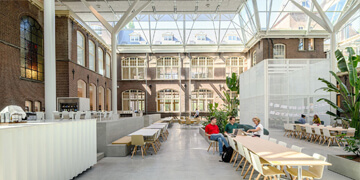
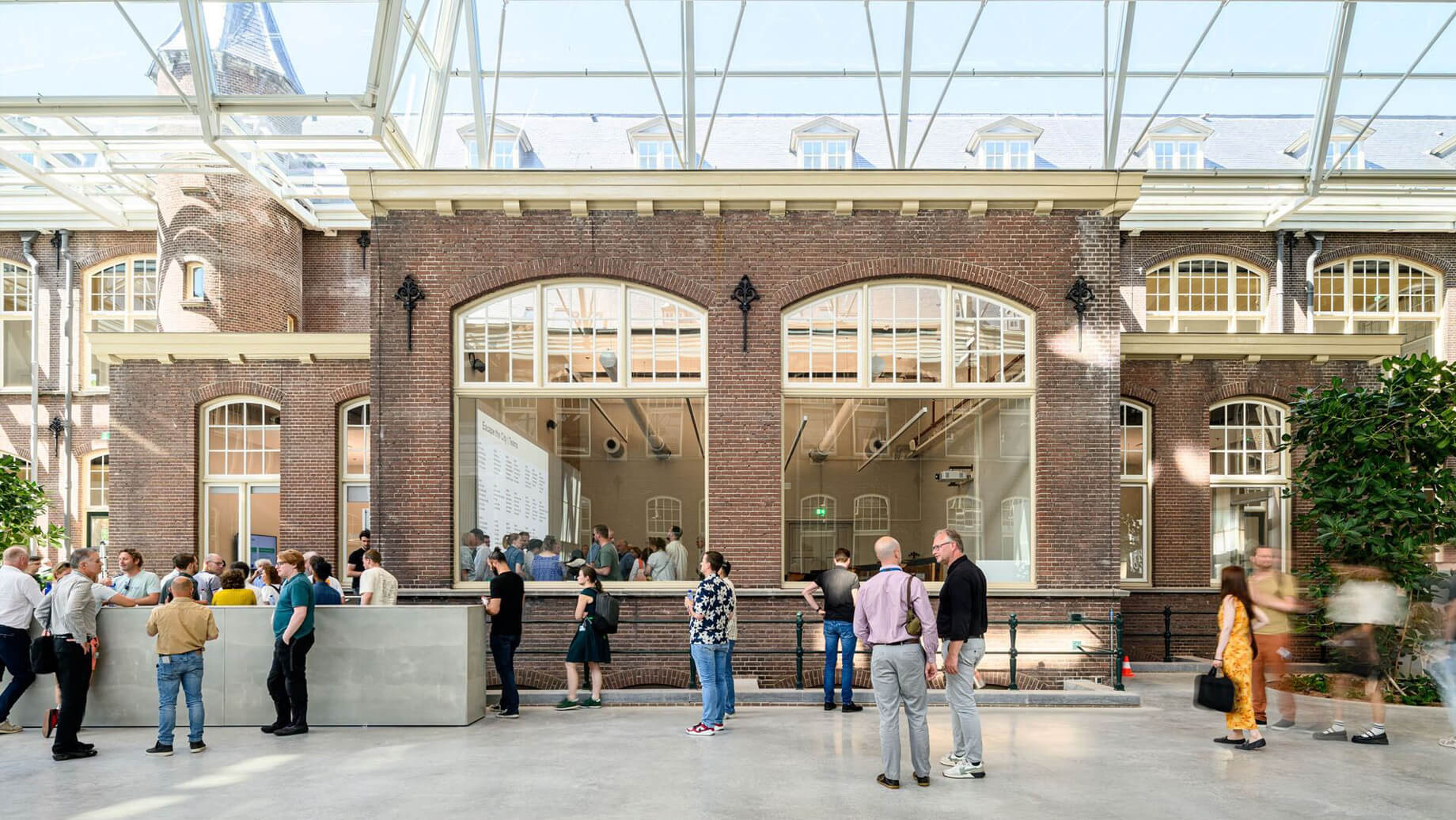
At the centre of this story is a building with a past. Originally constructed in 1912 as the Mining Faculty of TU Delft, the site is a historic monument.
When Haskoning acquired the building in 2021, the organisation chose to preserve the building’s identity. This decision reflects a broader philosophy: that reuse is not only more sustainable, but more meaningful.
The result is one of the Netherlands’ first Paris Proof national monuments, powered entirely by renewable energy and achieving an 80% reduction in energy consumption.
While the building provides the foundation for the workplace, the strategy defines how it performs. From the outset, Delft was designed to prioritise interaction as a core principle rather than a secondary outcome. This intent is embedded in the layout itself. Coffee points have been deliberately limited per floor, creating shared destinations that encourage movement and interaction. Entrance routes have been consolidated, ensuring that employees pass through central areas rather than entering the building anonymously.
These decisions may appear small, but they are highly impactful.
This is reflected in the experience data: 80% of employees agree that informal, unplanned meetings are well supported in the workplace, while 95% say informal social interaction is supported, highlighting the strength of these environments.
Further to its strong focus on connection, the Delft office also delivers consistently across core work activities. Individual-focused work (desk-based) is viewed as a critical workplace activity, and importantly, 83% of employees agree it is well supported, while planned meetings perform even more strongly (89%). Video conferencing, increasingly critical in hybrid working, is also well supported (77%). Crucially, the workplace also supports moments of pause. An overwhelming 94% of employees say the environment supports relaxing or taking a break.
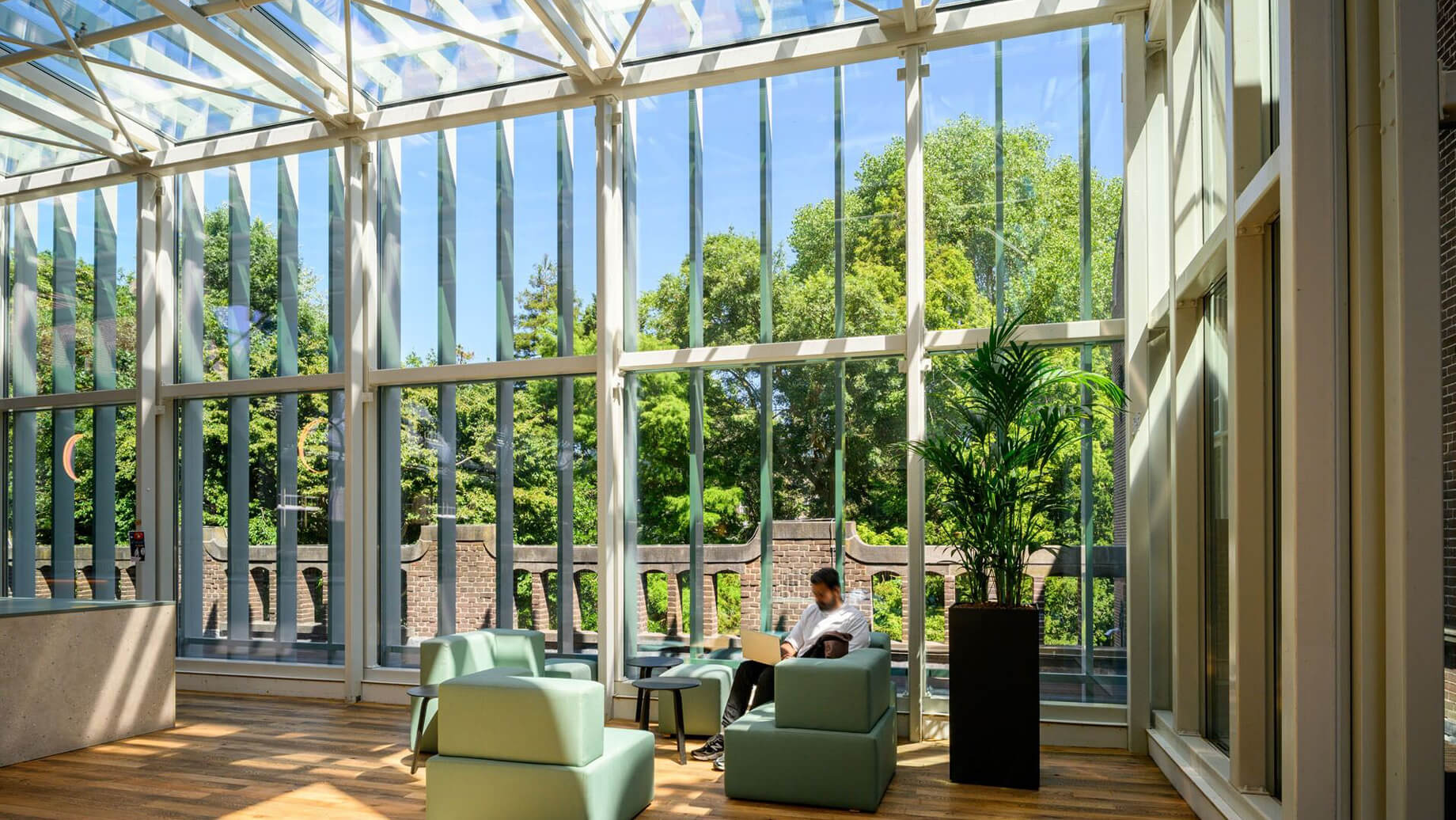
Beyond functionality, the Delft office has been designed to create an experience that people feel connected to. This is reflected in high levels of satisfaction with the physical environment: 91% of employees are satisfied with the atriums and communal areas, and 83% with the general décor. What truly differentiates the space, however, is its connection to Haskoning’s identity.
Throughout the building, murals and artwork showcase real projects delivered by employees, transforming the workplace into a reflection of the organisation’s work.
Central to Delft’s success has been data. Not in a retrospective measure, but as a driver of decision-making. By deploying the Leesman Essentials survey, Haskoning has gained a clear, structured understanding of how effectively the workplace supports employees and how experience varies across groups.
Haskoning’s Delft office demonstrates what is possible when design, data, and culture align. It is a workplace shaped by heritage and innovation, sustainability and performance, strategy and human behaviour.
Talk to one of our experts to find the best solution for your business.